Building a Deep Agent for Email Triage
I've been knee-deep in AI development, and let me tell you, building a deep agent for email triage with Langmith is like orchestrating a symphony. First, I set up my instruments — in this case, system prompts and sub-agents — then I conduct the performance with precision tools like Piest and Viest. The goal? To streamline email management, integrate calendar scheduling, and enhance agent performance through practical, hands-on implementation using Langmith. Let’s dive into how I made this work.
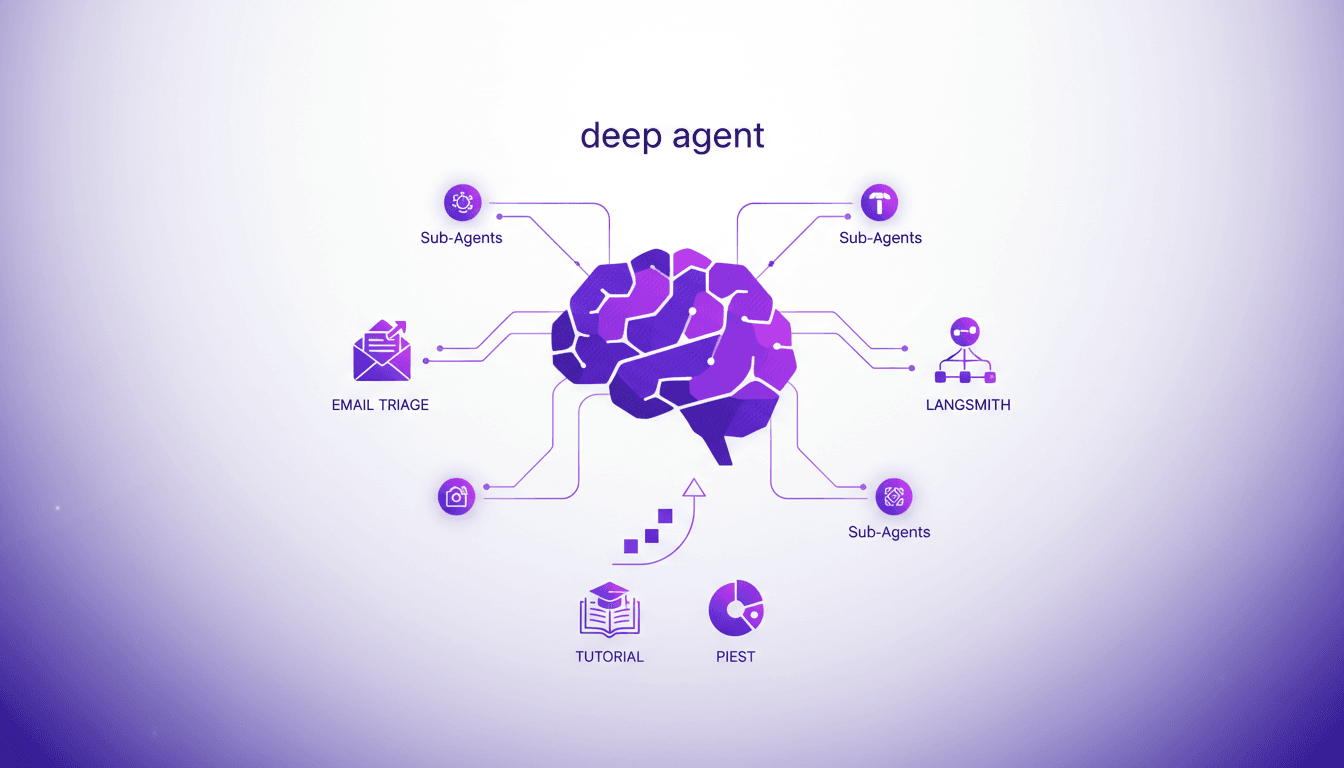
Diving into building a deep agent for email triage with Langmith is like orchestrating a symphony. (And I do mean 'orchestrating', because trust me, every piece has to sync or it turns into chaos.) First, I set up my system prompts and sub-agents — these 'instruments' that have to play in harmony. Then, I conduct it all with precision using tools like Piest, for writing tests, and Viest. The ultimate goal? To simplify everyday email management by integrating calendar scheduling and optimizing agent performance. With Langmith, I observed and evaluated every step, adding practical features like Langmith Fetch to pull in necessary data. But watch out, don't be fooled by the apparent simplicity, as performance can quickly fall apart if every piece isn't orchestrated just right. Ready to see how I made it all work? Let's dive in.
Getting Started with Langmith and Deep Agents
When I first dove into Langmith, I was a bit overwhelmed by its capabilities, but that's exactly what makes it so powerful. Langmith is designed for building intelligent agents, and I used it to craft a simple assistant for email triage. First and foremost, you need to understand the role of system prompts. They direct the agent's actions, and without them, the agent would be like a ship without a compass.
To set up a deep agent for email triage, you start by clearly defining your objectives. I ensured my agent could read incoming emails and decide on actions to take. Watch out for common pitfalls in initial configurations: poorly defined objectives can lead to unexpected agent actions.
Defining System Prompts and Agent Actions
System prompts are the soul of your agent. I structured my initial prompts to effectively handle email triage. The challenge is finding a balance between specificity and flexibility. Too much detail can make the agent rigid, while a lack of precision can render it ineffective.
I've learned the hard way that prompts need to be adjusted based on observed agent behavior. Sometimes, it's better to be less precise to allow the agent to adapt to unforeseen situations.
- Precision in prompts = better performance.
- Need to adjust based on observed results.
- Avoid overly rigid prompts.
Integrating Sub-Agents for Calendar Management
Sub-agents are crucial for handling complex tasks like scheduling. I set up a sub-agent for managing my calendar and integrated it with the main agent. This allowed me to delegate specific calendar-related interactions, like finding and scheduling appointments.
Of course, this wasn't without its challenges. For example, I had to ensure the sub-agent could access real-time calendar data. However, once these hurdles were overcome, the efficiency gains were notable.
"Delegating to sub-agents can transform complex task management into a smooth and efficient process."
Observability and Testing with Langmith, Piest, and Viest
Using Langmith for tracing and evaluating agent actions is essential. I implemented tests with Piest to ensure robust agent performance. With Viest, I wrote tests in JavaScript, providing deeper insights into the agent's behavior.
Langmith acts as a judge to validate outcomes. I can adjust agent behavior based on test results. It's an iterative process but crucial to ensuring the agent performs as expected.
- Tracing actions = better visibility.
- Regular testing with Piest and Viest for detailed insights.
- Continuous adjustment based on test outcomes.
Improving Agent Performance with Langmith Fetch
Langmith Fetch enhances data retrieval and processing. I integrated Fetch into my workflow, and it really boosted the agent's efficiency. However, you must balance performance improvements with associated computational costs.
In practice, I've noticed significant time savings and efficiency gains. The final tweaks I made optimized the agent's performance systematically.
- Fetch integration = performance gains.
- Balance between improvement and costs.
- Continuous optimization for better performance.
Building a deep agent for email triage with Langmith isn't just theory; it's hands-on work that integrates system prompts, sub-agents, and tests robustly with Piest and Viest. Here's what I found crucial:
- Precise prompts are non-negotiable to avoid ambiguity.
- Integrating sub-agents for calendar management can streamline workflows, but watch out for scheduling conflicts (like between 8 a.m. and 9 a.m.).
- Testing with Piest and Viest is essential to ensure the agent handles real-world use cases effectively.
Honestly, it's a real game changer for managing emails, though expect some initial tweaking. Ready to streamline your email management? Dive into Langmith today, build your agent, and see the results for yourself. For more insights and tips, check out the original video — it's like chatting with a colleague who's been through it. Watch it here.
Frequently Asked Questions

Thibault Le Balier
Co-fondateur & CTO
Coming from the tech startup ecosystem, Thibault has developed expertise in AI solution architecture that he now puts at the service of large companies (Atos, BNP Paribas, beta.gouv). He works on two axes: mastering AI deployments (local LLMs, MCP security) and optimizing inference costs (offloading, compression, token management).
Related Articles
Discover more articles on similar topics
Deep Agents with LangChain: Introduction
I've spent countless hours in the trenches of AI development, wrestling with deep agents. When I first encountered LangChain, it felt like stumbling upon a goldmine. Imagine launching two sub-agents in parallel to supercharge efficiency. Let me walk you through how I optimize and debug these complex systems, leveraging tools like Langmith Fetch and Paulie. Deep agents are the backbone of advanced AI systems, yet they come with their own set of challenges. From evaluation to debugging, each step demands precision and the right set of tools.
Continual Learning with Deepagents: A Complete Guide
Imagine an AI that learns like a human, continuously refining its skills. Welcome to the world of Deepagents. In the rapidly evolving AI landscape, continual learning is a game-changer. Deepagents harness this power by optimizing skills with advanced techniques. Discover how these intelligent agents use weight updates to adapt and improve. They reflect on their trajectories, creating new skills while always seeking optimization. Dive into the Langmith Fetch Utility and Deep Agent CLI. This complete guide will take you through mastering these powerful tools for an unparalleled learning experience.
LangChain Academy: Start with LangChain
I dove into LangChain Academy's new course to see if it could really streamline my AI agent projects. Spoiler: it did, but not without some head-scratching moments. LangChain is all about building autonomous agents efficiently. This course promises to take you from zero to hero with practical projects and real-world applications. You'll learn to create agents, customize them with middleware, and explore real-world applications. For anyone looking to automate intelligently, it's a game changer, but watch out for context limits and avoid getting lost in module configurations.

AI Evaluation Framework: A Guide for PMs
Imagine launching an AI product that surpasses all expectations. How do you ensure its success? Enter the AI Evaluation Framework. In the rapidly evolving world of artificial intelligence, product managers face unique challenges in effectively evaluating and integrating AI solutions. This article delves into a comprehensive framework designed to help PMs navigate these complexities. Dive into building AI applications, evaluating models, and integrating AI systems. The crucial role of PMs in development, iterative testing, and human-in-the-loop systems are central to this approach. Ready to revolutionize your product management with AI?

Claude Code: Unveiling Architecture and Simplicity
Imagine a world where coding agents autonomously write and debug code. Claude Code is at the forefront of this revolution, thanks to Jared Zoneraich's innovative approach. This article unveils the architecture behind this game-changer, focusing on simplicity and efficiency. Dive into the evolution of coding agents and the importance of context management. Compare different philosophies and explore the future of AI agent innovations. Prompt engineering skills are crucial, and the role of testing and evaluation can't be overlooked. Discover how these elements are shaping the future of AI agents.