Brain-Computer Interfaces: Advances and Challenges
I remember the first time I connected a brain-computer interface to a retinal prosthesis. It was like watching the future unfold in real-time. But here's the kicker: the tech is only as good as our understanding of the brain's plasticity and its convergence with AI. We're at a crossroads where neuroscience meets artificial intelligence, and brain-computer interfaces (BCIs) are at the forefront of this revolution. Let's dive into how we're building this future, the challenges we face, and the potential it holds. From advancements in BCI technology for vision restoration to neural engineering and retinal prostheses, and including a risk-reward analysis of BCI adoption, this interview with Max Hodak promises to be enlightening. Get ready to explore biohybrid neural interfaces and ponder the future of intelligence through BCIs.
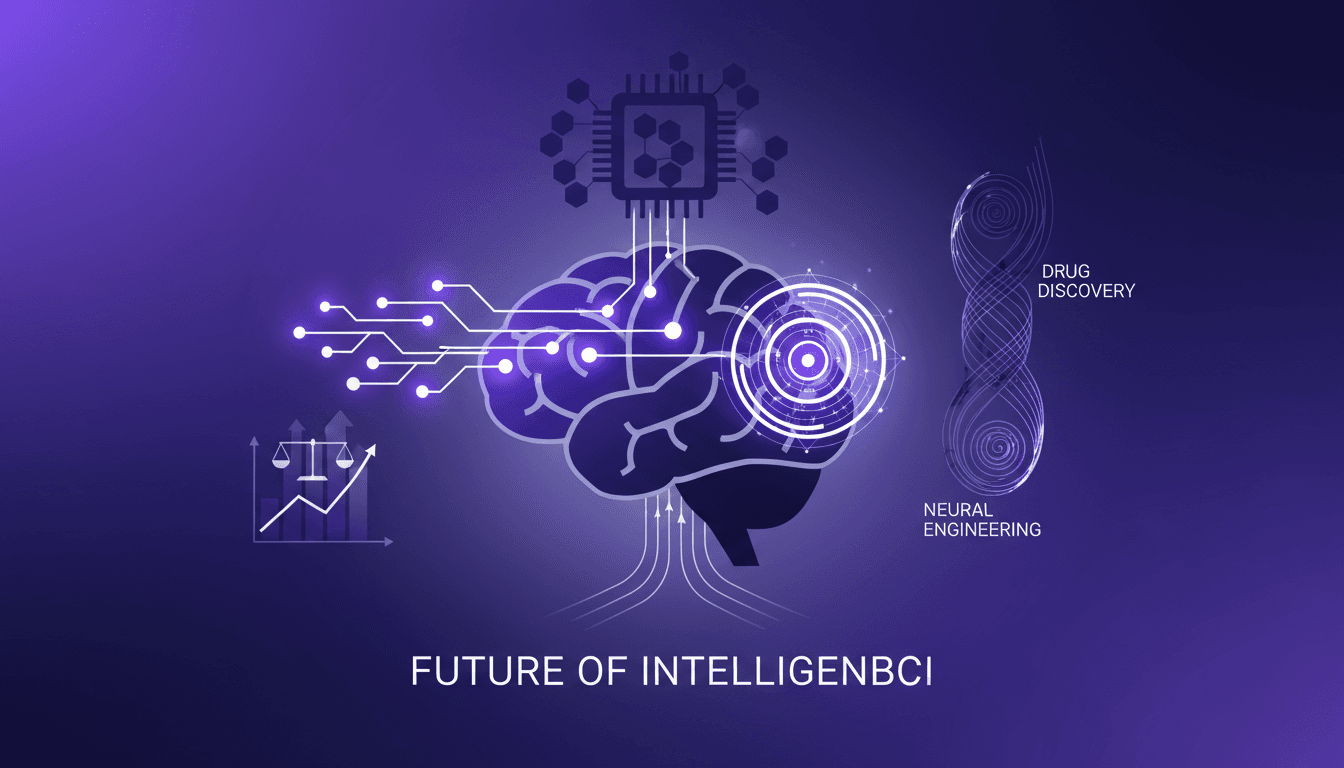
I remember the first time I connected a brain-computer interface to a retinal prosthesis. It felt like watching the future unfold before my eyes. But here's the thing: this technology is only as powerful as our understanding of brain plasticity and its convergence with AI. We're at a pivotal moment where neuroscience meets artificial intelligence, and BCIs are leading this revolution. In this interview with Max Hodak, we dive into how we're building this future, the challenges that lie ahead, and the immense potential it holds. Imagine restoring vision through BCI technological advancements or even the possibility of living up to a thousand years through biohybrid neural interfaces. But don't be fooled; every technological revolution comes with its own risks. We'll analyze the rewards and pitfalls of BCI adoption while pondering the future of intelligence. So, get ready to be captivated by this conversation where science and technology converge to redefine our future.
BCI Technology for Vision Restoration
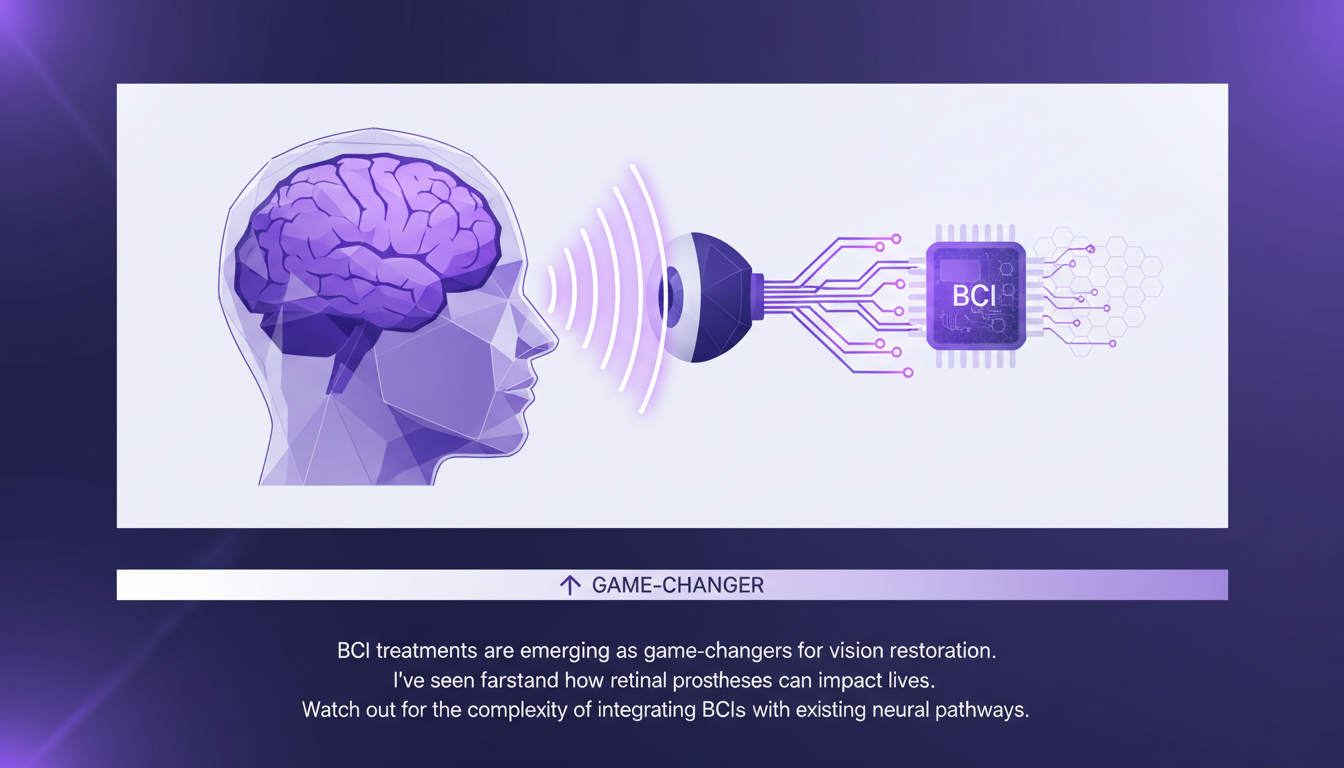
BCI (brain-computer interface) treatments are emerging as game-changers for vision restoration. I've witnessed firsthand how retinal prostheses can impact lives. Picture a 2mm x 2mm silicon implant under the retina that restores sight to the blind. Over 40 people have already received these BCI treatments to regain their vision. But watch out, integrating these interfaces with existing neural pathways is a complex task.
Efficiency in BCI deployment can drastically reduce restoration time. However, cost remains a significant barrier, although technological advancements are beginning to lower the entry point. There's even talk of the possibility that the first people to live to a thousand years are already among us, underscoring how transformative these technologies can be for our future. But let's be clear, every advance comes with its set of challenges and trade-offs.
Understanding Brain Plasticity in BCI Development
Brain plasticity is the brain's ability to adapt and learn. It's crucial in training BCIs effectively. I've iterated on multiple models to enhance learning with feedback loops. These loops allow the brain to adjust in real time, but there's a trade-off between speed and accuracy in neuroplastic adaptation.
In experiments, the brain was able to learn and adapt by fixing neuron weights and providing feedback. But watch out, neuroplasticity can be a double-edged sword; over-training can lead to inefficiencies. It's a bit like trying to sculpt a statue: too many chisel strokes and you risk ruining it altogether.
Neural Engineering and the Role of AI
AI accelerates the development of neural engineering solutions. I've personally orchestrated AI models to predict neural responses. The convergence of neuroscience and AI is not without its challenges. It's about balancing AI complexity with practical BCI applications.
AI-driven BCIs can potentially enhance brain capabilities, but this requires a deep understanding of the brain's internal workings. In parallel, applications like Surviving the AI Era show how to navigate this complex field. Integrating these technologies into our daily lives could be a game-changer, but one must be aware of the risks.
Biohybrid Neural Interfaces: Potential and Pitfalls
Biohybrid interfaces combine biological and artificial elements. I've experimented with biohybrids to extend BCI functionalities. The potential is vast, but so are the risks. Integration with existing biological systems is a major hurdle.
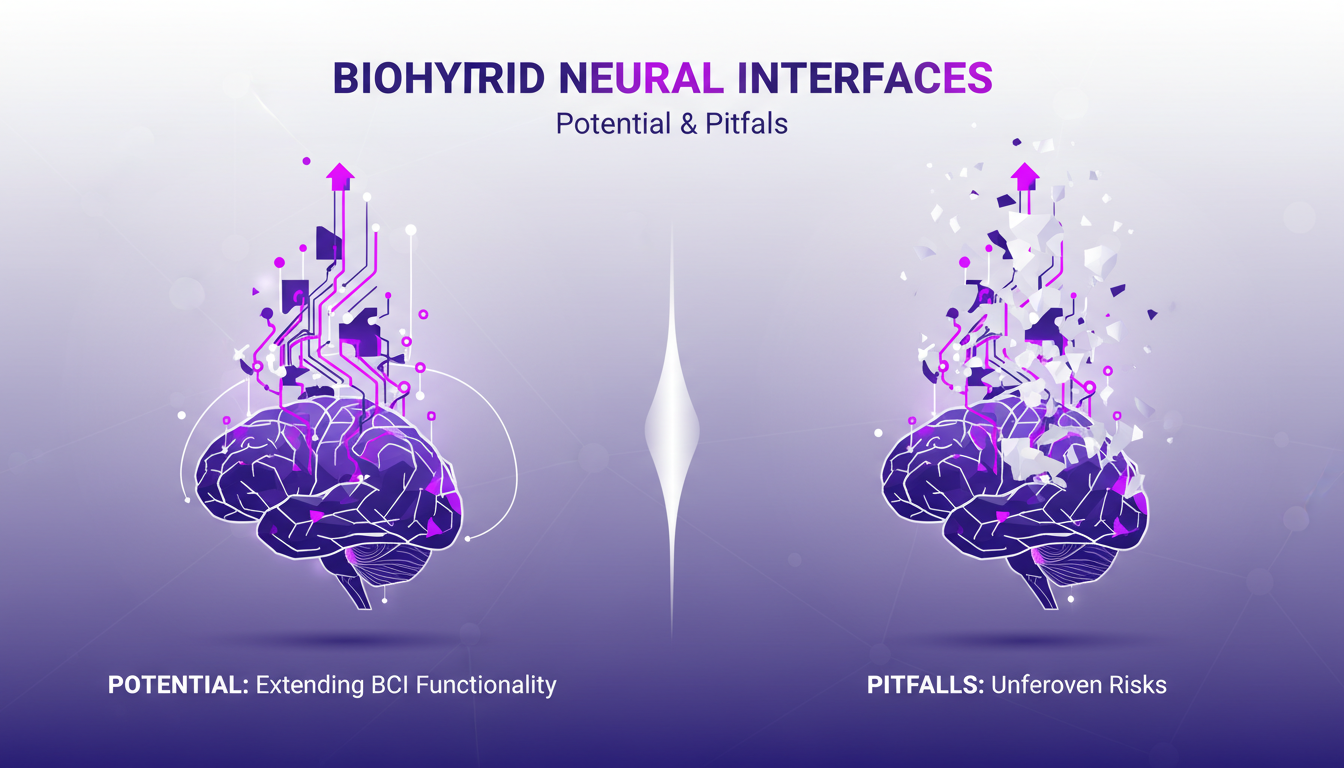
Biohybrids could redefine the future of intelligence augmentation. However, every step forward must be carefully measured. As with any innovation, caution is key to avoid unforeseen consequences.
Risk-Reward Analysis in BCI Adoption
Adopting BCIs involves significant risk-reward considerations. I've faced challenges balancing innovation with ethical concerns. The reward of BCIs is truly transformative, especially for the visually impaired.
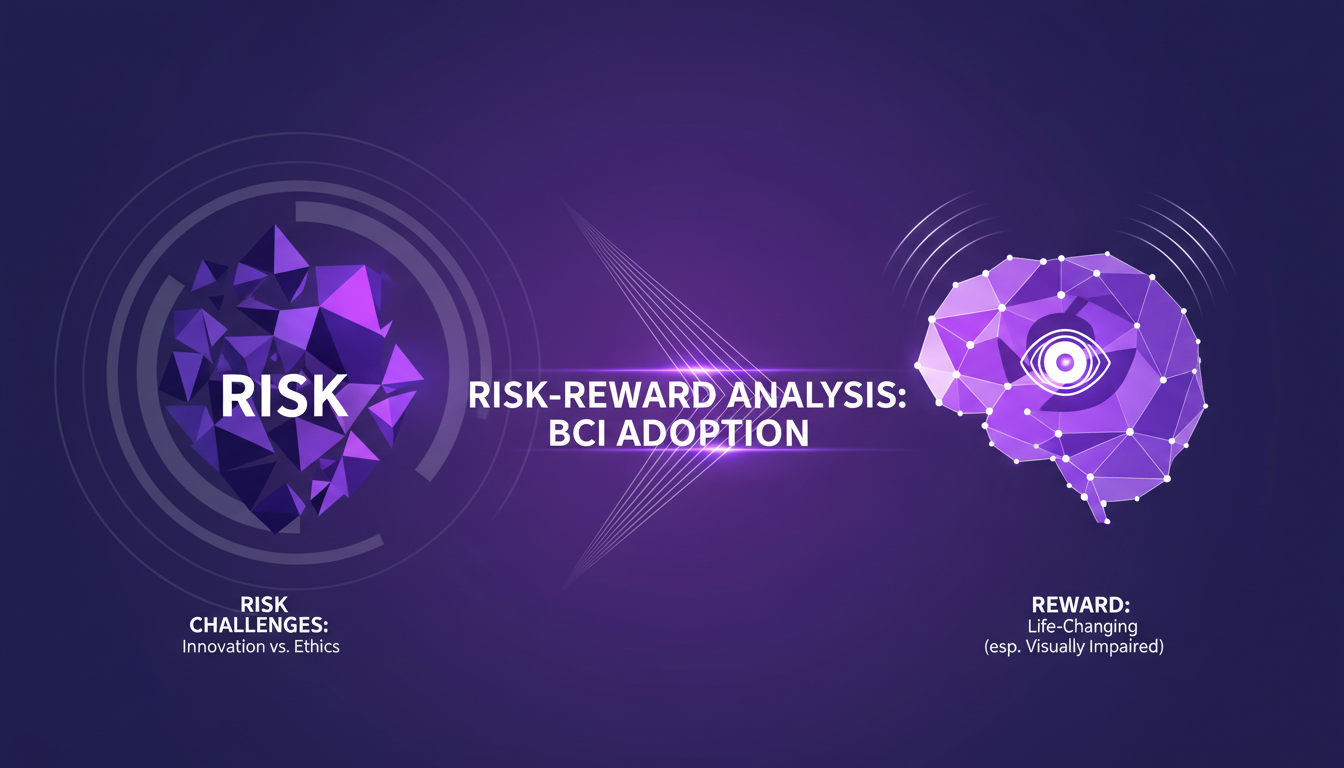
The long-term effects of BCI usage are still under study. Strategic risk management is essential in BCI deployment. It's not just about jumping on the first opportunity, but carefully calculating each move to ensure a sustainable success.
Building the future with brain-computer interfaces (BCIs) is a journey packed with potential and pitfalls. I've been deep into vision restoration and intelligence augmentation, and let me tell you, the path is both complex and rewarding. First, advancements in BCI for vision are not just a promise; they're already transforming lives. Next, brain plasticity expands our playground, but watch out for the ethical implications. Neural engineering with retinal prostheses is pushing us to rethink biological limits, but we need to pilot it carefully. Finally, the convergence of neuroscience and AI is a real game changer, but stay alert to technical and ethical challenges.
We're just at the beginning, yet those who could live to 1000 might already be among us. In the next 10 years, the goal is to turn these scientific breakthroughs into tangible realities. Join me in exploring these advancements further. Check out the original video "How To Build The Future: Max Hodak" for a full insight, and let's discuss how we can practically build this future together. Watch the video here.
Frequently Asked Questions

Thibault Le Balier
Co-fondateur & CTO
Coming from the tech startup ecosystem, Thibault has developed expertise in AI solution architecture that he now puts at the service of large companies (Atos, BNP Paribas, beta.gouv). He works on two axes: mastering AI deployments (local LLMs, MCP security) and optimizing inference costs (offloading, compression, token management).
Related Articles
Discover more articles on similar topics
Surviving the AI Era: Brutal Truths and Tips
I've been deep in the AI trenches, and let me tell you, it's not just about surviving; it's about thriving. With 700,000 graduates in England struggling to find jobs, AI is redrawing the job market's boundaries. Yet, I've learned this challenge is also an opportunity to amplify human capabilities and rethink careers. I'll walk you through how I've taken personal responsibility and crafted my own opportunities, and how you can do the same. Together, we'll explore the impact on traditional roles disrupted by AI, the importance of charting your own course, and how to harness AI to supercharge your skills. Get ready to rethink your professional future, armed with essential sales techniques and entrepreneurial skills.
Baguettotron: AI Integration on Zip Disk
I still remember the first time I tried to fit an AI model onto a zip disk. It was like trying to squeeze a modern engine into a vintage car. But that's precisely the challenge the Baguettotron project threw at me, and here's how I tackled it. The Baguettotron is this fascinating mix of retro tech and cutting-edge AI. Picture running a 320 million parameter AI model on a tiny 900 MB disk. Sounds crazy, right? But it's doable. We're diving into this technical adventure, discussing specs, compatibility, and the hurdles like finding those elusive disks. Hang tight, because we'll also touch on the unique marketing aspects of this project.
Chess AI: Strategies and Future
I remember my first encounter with a chess engine. It felt like playing against an invisible yet incredibly powerful mind. Since then, AI has transformed our ancient game, and I'm here to show you how. Chess has always been a battle of wits, but with AI's arrival, everything shifted. Take Magnus Carlsen, for instance, using these advancements to refine his strategies. In this episode, we'll dive into how AI has redefined the chess landscape, from detecting cheating to new variants like chess tennis. It's a fascinating journey through time and technology, and if you've ever been surprised by a 2800-rated opponent, you know exactly what I mean.
AI in India: Revolution and Global Impact
I've been in the AI trenches for years, and let me tell you, what's happening in India is nothing short of revolutionary. With over 100 million people using Chat GPT weekly, and a third of them being students, we're tapping into something profound. This isn't just about technology; it's about transforming economies and societies. By 2028, a significant portion of the world's intellectual capacity might be locked in data centers. Imagine super intelligence on the horizon. India is at the forefront, and the economic and social impact will be colossal. Let's discuss learning programs, automation, democratization, and regulation of AI.
AI in Film: How Site Dance 2.0 is a Game Changer
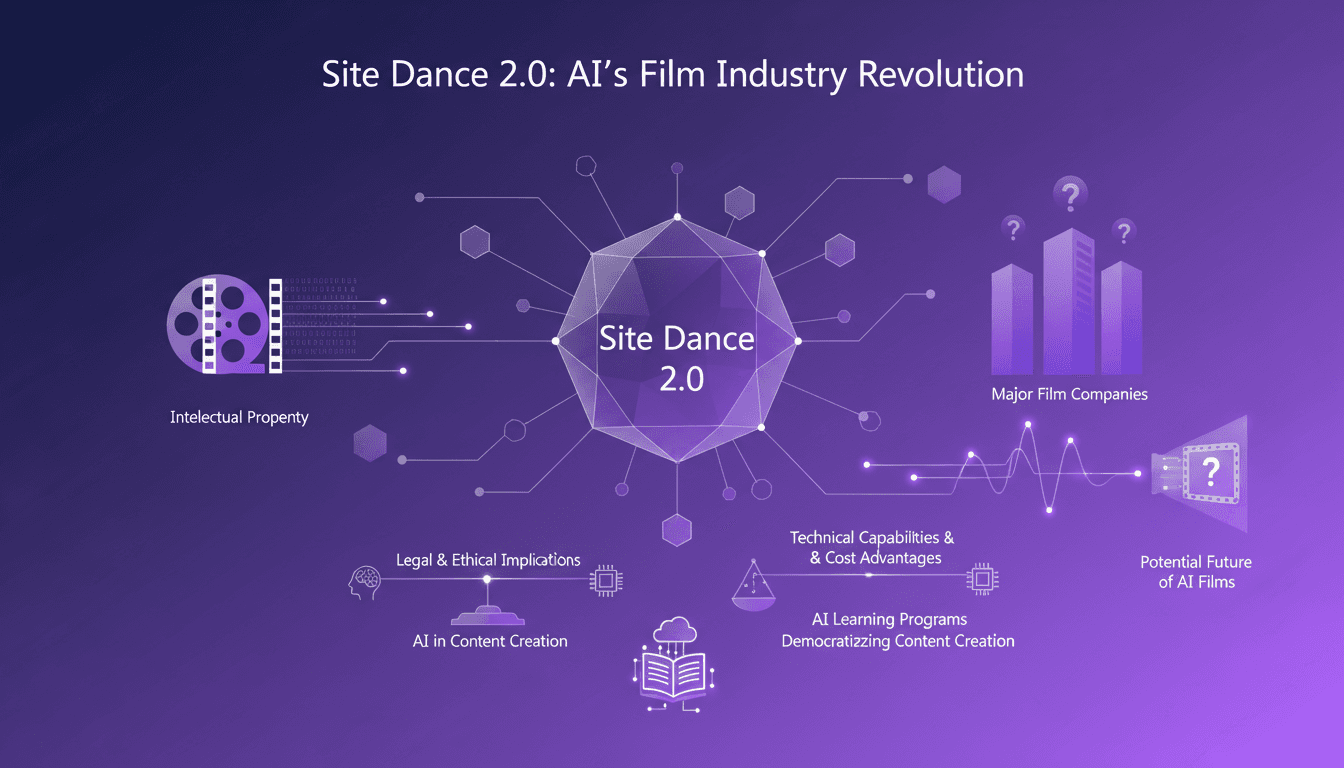
I still remember the first time I saw Site Dance 2.0 in action. It was like watching the future unfold right before my eyes. This isn't just a technical upgrade; it's a revolution in the film industry. We're talking massive cost savings and enormous creative potential. Imagine slashing shooting and special effects costs by millions while speeding up production. But beware, it comes with complex questions — intellectual property, legal implications, it's all on the table. Major companies like Disney and Sony are already reacting within 48 hours. With Site Dance 2.0, we're no longer talking science fiction but tangible reality. Let me show you how it's changing the way we create, produce, and view films.